
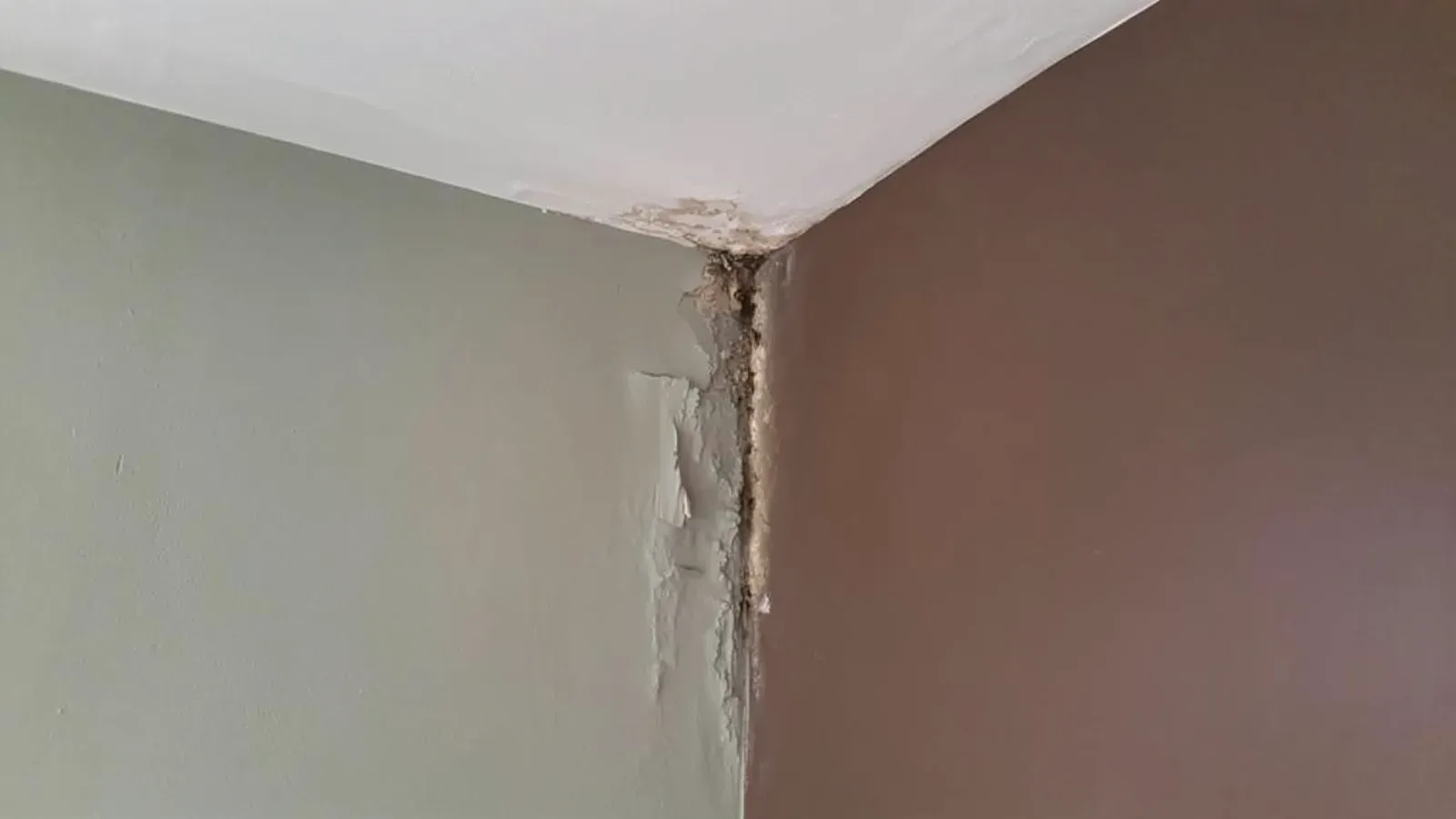
Signs you need this
- • A brown or yellow ring spreading across a ceiling, usually under a bathroom, kitchen, or an upstairs unit's plumbing wall
- • Drywall that has gone soft, is bubbling away from the studs, or dents inward under a light push
- • A musty smell in a bedroom or hallway that shows up a day or two after a storm or a running toilet upstairs
- • Paint that's peeling or bowing off the wall in sheets, tape seams that have separated and curled
- • A pipe lets go overnight in a century-old triple-decker and water is actively coming through a first-floor ceiling
- • An ice dam backs up over a winter thaw and drips through the top-floor ceiling for days before anyone notices
- • A property manager gets a tenant complaint about a stained ceiling and needs it fixed before it becomes a habitability issue or an insurance claim
Reading the Damage Before Opening the Wall
Water damage in a Lowell triple-decker rarely stays where it shows. The stain on a first-floor ceiling marks where water finally soaked through enough layers of plaster or drywall to become visible, not where the water actually is. Lowell Quality Drywall & Plaster starts every water damage call with a moisture meter, not a utility knife, checking the drywall itself, the framing behind it, and any insulation in the cavity. That reading decides how much comes out. Cutting back to a clean, dry, framed edge matters more than cutting the smallest possible hole, because closing wet framing behind new board just delays a mold problem by a few weeks.
Why Lowell’s Housing Stock Makes This Common
Lowell’s housing is old and dense. The city’s enormous stock of late-19th and early-20th-century triple-deckers and two-families means shared plumbing stacks run through party walls and ceilings between units, so a failure two floors up shows up as a stain on someone else’s ceiling. Over 60 percent of Lowell residents rent, which means landlords and property managers, not just homeowners, are frequently the ones calling about a stained ceiling that needs to be fixed before a tenant complaint becomes a habitability issue. Add New England’s freeze-thaw winters, where ice dams back meltwater up under roofing and into top-floor ceilings over the course of days rather than all at once, and water damage becomes one of the most consistent call types in the city, not an occasional emergency.
Matching the Finish, Not Just Patching the Hole
A water-damaged ceiling repair is only invisible if the finish matches. Older Lowell homes carry a mix of finish types, hand-troweled plaster skim in some units, sprayed knockdown or orange-peel texture in others, flat Level 5 drywall in newer renovations or mill-loft conversions downtown. Lowell Quality Drywall & Plaster matches the existing texture and finish level before priming, using the same joint compound and corner bead approach the original surface used, so a patch on a triple-decker ceiling doesn’t read as a patch once it’s painted.
Standard Board Versus Mold-Resistant Board
Not every water repair calls for mold-resistant board, but repeat-risk areas do: bathrooms, basement walls, and any ceiling that’s already failed once. Mold-resistant board (purple board, M2Tech-type facings) costs modestly more than standard USG Sheetrock or Gold Bond but resists the moisture that standard paper-faced gypsum board will wick and hold. In multi-unit buildings where a demising wall or a fire-rated assembly separates units, restoring that assembly to its rated configuration after water damage isn’t optional. It matters for insurance and for code compliance under the Massachusetts State Building Code (780 CMR).
Insurance Documentation That Actually Helps a Claim
Landlords and property managers dealing with Lowell’s high renter turnover need repairs that are fast and defensible on paper. Lowell Quality Drywall & Plaster photographs the damage before demo, logs moisture meter readings at the start and end of the dry-out, and hands that documentation to the customer for their insurance adjuster. That paper trail is often the difference between a claim that gets paid promptly and one that gets questioned.
When It’s Not Just a Water Problem Anymore
If a wall or ceiling has been wet for more than a couple of days before anyone calls, which happens often with slow ice dam leaks or a leak in a vacant unit between tenants, mold growth is a real possibility once the board comes down. Lowell Quality Drywall & Plaster checks for it before closing anything back up, and if it’s present, the job shifts toward a mold-focused scope rather than a straight water repair, so the wall doesn’t just look fixed, it actually is.
Materials & standards
Products & materials we use
- USG Sheetrock
- National Gypsum Gold Bond
- Georgia-Pacific ToughRock
- mold-resistant board (M2Tech)
Standards & codes we work to
- Massachusetts State Building Code (780 CMR)
- ASTM C1396
- GA-214 finish levels
- MA Construction Supervisor License (CSL)
- MA Home Improvement Contractor (HIC) registration
What the terms mean
- moisture metering
- mold-resistant board
- knockdown and orange-peel texture matching
- joint compound
- mud and tape
- corner bead
- Level 5 finish
- fire-rated assembly
- demising wall
Options & variants
| Option | When it applies | Cost |
|---|---|---|
| Spot ceiling patch | Small, contained stain from a one-time leak that's already fixed at the source | Lower cost, single-day turnaround |
| Full wall or ceiling section replacement | Water traveled along a joist bay or wall cavity beyond the visible stain | Moderate, driven by square footage removed |
| Mold-resistant board rebuild | Bathroom, basement, or any area with repeat moisture exposure | Slightly higher material cost, lower long-term risk |
| Insurance-documented repair | Homeowner or landlord is filing a claim | Same repair scope, plus photo/moisture-log documentation |
What affects cost
- • How far the water traveled before it stopped: a stain the size of a dinner plate can hide wet insulation and framing several feet beyond the visible mark
- • Whether the ceiling has a texture (knockdown, orange peel, or a smooth Level 5 skim) that has to be matched, not just patched
- • Access: a first-floor ceiling under a second-floor bathroom in a triple-decker is straightforward; a ceiling under a tub or shower pan can mean opening tile or flooring above
- • Whether mold is present once the board comes down, which shifts the job from a repair to a remediation-adjacent scope
- • Standard drywall versus mold-resistant board, and whether insulation, vapor barrier, or fire-rated assembly work (common in multi-unit demising walls) needs to be restored to code
What to expect
- 1
Same-day or next-day call
Describe the leak and whether the source is stopped. If it's still active, get the water shut off first.
- 2
On-site moisture assessment
A moisture meter checks the drywall, framing, and insulation to map exactly how far the water traveled, not just what's visibly stained.
- 3
Careful demo
Only the wet material comes out, cut back to dry, sound framing, minimizing disruption to the rest of the wall or ceiling.
- 4
Dry-out confirmation
Framing is rechecked before any new board goes up, so nothing gets closed in wet.
- 5
Rebuild and finish
New board, standard or mold-resistant depending on the area, is taped, mudded to match the surrounding texture and finish level, and primed ready for paint.
- 6
Documentation handoff
Photos and moisture readings are provided for any insurance claim in progress.
When this isn’t the right call
- If the ceiling or wall has visible black mold growth, not just a water stain, mold drywall replacement is the better fit.
- If the damage is old lath-and-plaster cracking from settling or age rather than an active or recent water event, plaster repair and plaster-to-drywall conversion is the better fit.
- If the leak source itself, a pipe, roof, or appliance, hasn't been fixed yet, that needs a plumber or roofer first. Lowell Quality Drywall & Plaster can still assess but won't close up a wall over an active leak.
Frequently asked questions
How fast can you get to an active leak in Lowell? +
Lowell Quality Drywall & Plaster treats an active water leak as an emergency call and prioritizes same-day or next-day response, especially in multi-unit triple-deckers where water is traveling to the unit below.
Will you match my ceiling texture? +
Yes. Whether the ceiling has a knockdown texture, an orange-peel spray, or a smooth Level 5 skim finish, the repair is matched to the surrounding surface so the patch doesn't stand out once it's painted.
Do I need to wait for insurance approval before you start? +
Not for the assessment or dry-out. Lowell Quality Drywall & Plaster documents the damage with photos and moisture readings a customer can submit to their adjuster, and can move forward on the repair once the homeowner or landlord is ready.
My upstairs neighbor's leak damaged my ceiling. Can you help even though it's not my pipe? +
Yes. This is common in Lowell's triple-deckers and condo-converted buildings. The repair scope is the same regardless of whose plumbing caused it; documentation for insurance or landlord reimbursement is provided either way.
How do I know if the drywall needs to be replaced or just dried out and repainted? +
If gypsum board has stayed wet more than a day or two, or if it's soft, bubbling, or sagging, it has to be cut out and replaced. A brief exposure that's caught fast can sometimes be dried and repainted, but a moisture meter reading is the only reliable way to tell.
What happens if you find mold once you open the wall? +
The scope shifts to make sure remediation happens before any new board is hung. Lowell Quality Drywall & Plaster will flag it immediately rather than covering it back up.
Should I use mold-resistant board even though I just had a one-time leak? +
In bathrooms, basements, and any area with repeat moisture risk, yes, it's a modest upcharge that reduces the odds of a repeat call. For a one-time leak in a dry area like a bedroom, standard board is fine.